
Film Music Zeitgeist
Technology for the times

The soundtrack you hear in a cinema isn’t just music - it’s the audible DNA of the era that created it. Every shift in film scoring - from the silent era of piano or organ accompaniment to the immersive Dolby Atmos swirl of a space disaster - mirrors the news headlines, the street fashion, the political mood and the available technology of its moment.

As a score mixer, music editor, producer and composer who has spent forty years across hundreds of film and TV projects and albums, bridging Abbey Road’s analogue past with today’s limitless digital present, I’ve watched this evolution unfold in real time. The tools don’t merely reflect culture; they amplify it, accelerate it, and sometimes predict it.
Early primitive instruments evolved in lockstep with human culture and technology: bone flutes and conches became shawms and Roman trumpets , which became clarinets and bugles, then saxes and trumpets. And the evolution continued into the modern era, resulting in the Akai EWI – the electronic wind instrument that served as the lead melodic voice on the dystopian score for Dark City.
Similarly, the very means of capturing sound evolved in parallel: wax cylinders became vinyl records and mono and stereo tape recordings. Then came analogue multitrack tape, digital multitracks and CDs, WAVs, MP3s, and the increasingly complex DAW systems such as Pro Tools that define modern production.

Let’s travel back to the beginning.
The earliest humans made music long before they had language. Forty-thousand-year-old bone flutes found in European caves prove it: simple, breathy melodies that must have echoed the rhythms of hunting, gathering and ritual. No notation, no technology - just voice and bone.

Then came the church. For centuries sacred music was vocal only; the human voice was considered the purest instrument of God. The invention and adoption of the pipe organ changed everything.
Suddenly harmony, sustain and sonic depth were possible. The church organ didn’t just add polyphony - it pushed composers to write the rules of Western music and handed those rules to every composer who followed.

Fast-forward to the early 1700s. Bartolomeo Cristofori invents the piano. For the first time a keyboard player could control dynamics with touch alone. Composers responded: Beethoven’s beautifully expressive sonatas and Chopin’s intimate nocturnes would have been impossible on the harpsichord.
The new instrument both enabled and demanded a new emotional language that perfectly suited the Romantic movement - grand, emotional, individualistic - just as Europe itself was being reshaped by revolution and industry.
By the late nineteenth century the parallels between visual art and music became explicit. Impressionist painters blurred light and colour; Debussy and Ravel blurred harmony and timbre. Recording technology was still primitive (wax cylinders, early shellac), yet the urge to capture fleeting atmosphere drove both disciplines. The development of multi-track tape in the 1950s and 1960s turbo-charged that freedom. Suddenly musicians could layer, edit, reverse and manipulate sound in ways that mirrored the accelerating psychedelic pace of modern life.

The electric guitar (Les Paul’s solid-body experiments in the 1940s) gave teenagers a loud voice. Rock ’n’ roll poured out - literally - the fashions, rebellion and optimism of the 1950s. The theremin, invented in 1920, brought eerie, otherworldly tones to sci-fi; the Moog synthesiser (1964) did the same for pop.
Wendy Carlos’s Switched-On Bach (1968) proved the synthesiser could reinterpret the past while sounding utterly of its time. Joe Meek’s 1962 instrumental hit “Telstar” celebrated the first communications satellite with cavernous echo and a futuristic tone - the sound of the Space Age itself.

And then, on the very same day - 5 October 1962 - two quintessentially British cultural twins were born. The Beatles released “Love Me Do”; the first James Bond film, Dr No, opened in cinemas. John Higgs, in his brilliant book Love and Let Die, shows how these twin events cracked open the British psyche. One offered love, collaboration and working-class swagger; the other offered suave, ruthless individualism and imperial nostalgia. The cultural weather vane had swung. Film music and pop music would never again be separate conversations.

The 1970s and 1980s accelerated the fusion. Punk’s raw, three-chord urgency was enabled by cheap cassette four-tracks and DIY studios - exactly the sonic parallel to ripped jeans and safety pins.
New Romanticism dressed synth-pop in frills and eyeliner.
The Fairlight CMI sampler (used by Peter Gabriel and Kate Bush) let composers steal and reshape real-world sounds. Art of Noise’s “Close (to the Edit)” (1984) was built entirely from sampled objects and drum machines - an aural collage that encapsulated the breakthrough era that initiated the modern digital revolution
My music career started in 1986, just as this digital revolution was getting a foothold, and I embraced these innovations entirely in the projects I worked on:

By the early 1990s digital multi-track (48-track DASH machines) and the arrival of Pro Tools changed the game again. The classical crossover experiments of Vanessa-Mae and the group Bond showed exactly what the new technology could do. A paper score of Bach’s Toccata and Fugue was digitised into a MIDI file, and from there a synth arrangement was constructed. We built percussive vocal samples into drums and dance-style loops, used a synth tone to track and shadow Vanessa's violin, and overdubbed a tightly recorded orchestra - classical DNA spliced with club-culture energy. With Bond I took the idea further with Tchaikovsky's 1812, fusing the acoustic string quartet with electronic production, beats, samples, effects and processed orchestra. These hybrid techniques crossed directly into film music production: composers could now fuse traditional orchestration with sampling, synthesis and modern grooves, creating scores that felt both timeless and utterly of the moment. All of it was made possible by the advent of affordable MIDI sequencing, digital sampling and ever-more-powerful workstations.

This fusion powered hybrid film scores. Drum ’n’ bass rhythms and the Akai EWI as lead melodic instrument drove the dystopian world of Dark City (1998). In From Hell (2001), the programmed elements and filtered live orchestra formed a key part of the soundscape accompanying the drug scenes; the heavily processed orchestral layers blurred the line between reality and dream state, perfectly mirroring the film’s gritty, hallucinatory atmosphere.

Then came Gravity (2013). Steven Price's score was crafted as an immersive, three-dimensional soundscape that didn’t just support the visuals - it surrounded the audience in the silence of space and the roar of re-entry. The same year IMAX cinema and high-speed connectivity were reshaping how we experienced everything; the score anticipated the new expectation of total immersion.
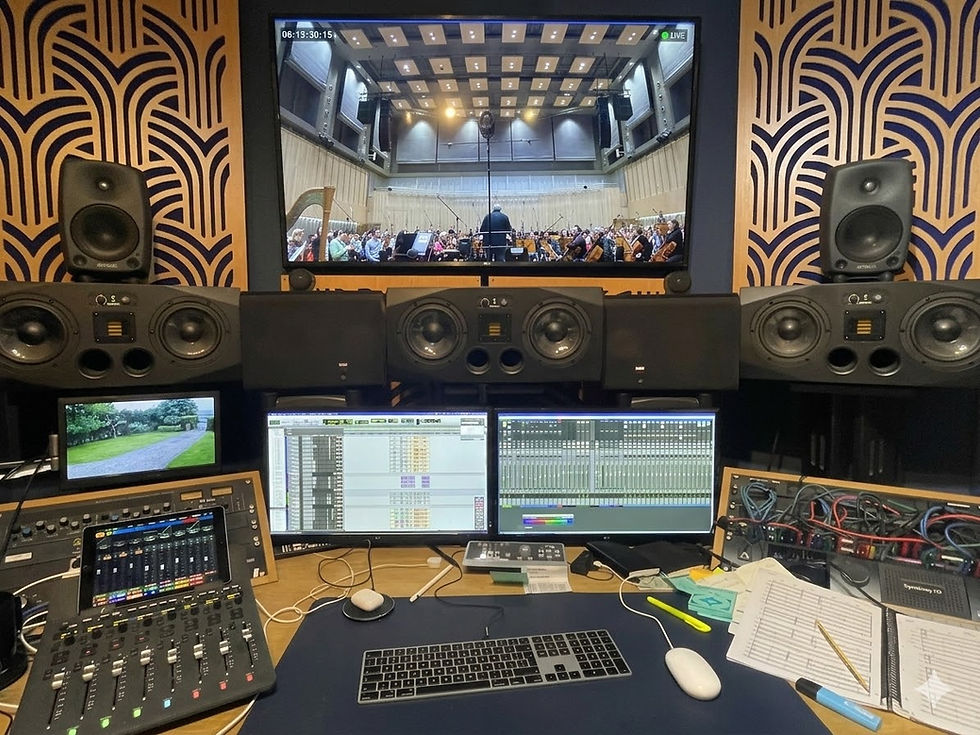
The Covid lockdowns of 2020–21 proved the point once more. The sheer power of the latest technology enabled music producers to use their own studios to remotely and separately create, write, record and mix music, while retaining the highest Hollywood standards at all times. In my case, I was sending huge mixes and massive files direct from my studio in Stratford Upon Avon straight to dubbing theatres in LA or London. In other cases, it was possible to record orchestras remotely in studios around the world in areas not yet affected by the pandemic. High-speed internet and sophisticated DAWs made real-time collaboration across continents possible; remote recording, cloud sessions and plugin emulations of vintage gear kept film and TV music flowing. The technology that had once amplified 1960s optimism had now evolved into something that kept an entire industry alive during global isolation.
Today the palette is almost infinite. We have access to every acoustic and world-music instrument ever invented, every synth ever dreamed and vast sample libraries. We have the choice of using digital emulations of classic gear - or the original real analogue synths, outboard equipment, live ethnic instruments and musicians’ performances.

The very sound (or faithful emulation) of analogue warmth and real instruments satisfies our deep-rooted nostalgia for the halcyon ideals and trends of the 1950s, 60s and 70s - those golden decades of post-war optimism, social revolution, raw rebellion and analogue soul that we still crave in an increasingly isolated, digital world.
And yet the core truth remains unchanged since humans first crafted those prehistoric bone flutes: music is the sound of the times we live in. Culture and the advances in technology have always gone hand-in-hand, each propelling the other forward, to help us arrive at this inevitable destination. As someone who began at Abbey Road cutting tape with a razor blade and now mixes hugely complex scores in Pro Tools, I feel extraordinarily lucky to stand at this particular crossroads. The vast array of technical resources and musical influences available to today’s composers and mixers is not a luxury - it is the inevitable destination of a journey that began when the first human picked up a hollow bone and blew into it.

The film music zeitgeist has always been technology for the times.
The only question is:
what will we make it sound like next?


Comments