
Beyond the Credits Part 2: What a Film Score Mixer Actually Does (And Why It Can Make or Break a Film)
Updated: Mar 21
If you scroll through the end credits of almost any big film, you’ll spot the usual music roles: composer, orchestrator, conductor, music editor… and then, usually tucked away near the bottom: Score Mixer.
To a lot of filmmakers - and even some musicians - it still sounds a bit mysterious. The composer writes the music, the orchestra plays it… so what exactly does a score mixer do?

In simple terms, I’m the last person to shape the score before it meets the picture, dialogue and sound effects. The composer creates the ideas which are then combined into a finished soundtrack that hits emotionally, sits perfectly in the mix, and survives everything from a cinema dub stage to a smartphone speaker. It’s the job that sits right at the crossroads of music, storytelling and technology - and after 40 years doing it (starting at Abbey Road and going fully freelance in 1993), I can tell you it really can make or break a film.
From the Composer’s Vision to the Final Cinematic Sound
Every score starts with the composer building themes and mock-ups so the director can feel how the music will support the story. Once that’s signed off, we move into recording.
That’s when I get properly stuck in. Film recording is nothing like making an album. Everything has to lock to picture - sometimes to the exact frame - and the final mix must leave room for dialogue and effects.
When I mixed the Oscar-winning score for Gravity, for example, the music had to feel like part of the film’s actual sound design, floating and swirling around the audience in space. Getting that seamless blend of orchestra and electronics right was everything.
Recording the Orchestra - and a Whole Lot More
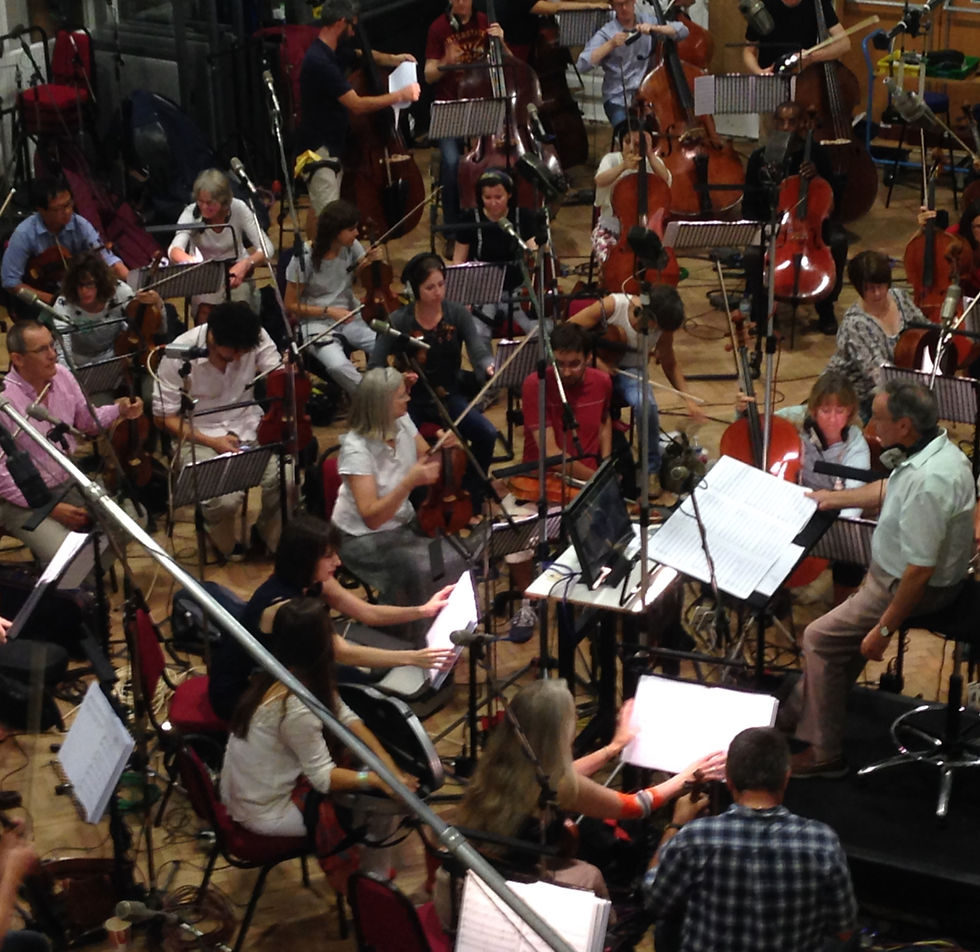
The classic image is still true: a huge orchestra on a scoring stage, conductor watching the picture. But these days that’s only the start. Most of the scores I work on are hybrid - orchestra plus electronics, rock band, choir, world instruments, synths and sound-design textures all living in the same cue. I’ve mixed everything from the driving rock-orchestra hybrid scores of Suicide Squad and American Assassin to the sweeping natural-world palettes on the Our Planet series and David Attenborough: A Life on Our Planet.
The Recording Engineer and the Score Mixer Aren’t Always the Same Person

Sometimes I wear both hats (for example as in From Hell and William Tell) - recording on the scoring stage, or occasionally using mobile location recording equipment to work in non-studio spaces (as with the Royal Shakespeare Company) - and then mixing later. Other times a house engineer captures all or some of the sessions (for example in London, Los Angeles, Glasgow or Vienna) and I take over for the final mix, concurrently or even weeks or months later. Both approaches work; what matters is crystal-clear communication. The way the orchestra is captured on the day directly affects what I can do in the mix.
Capturing the Performance

During the biggest session you might have 100+ musicians playing at once. We use layers of mics: close mics for detail, main orchestral mics (including a Decca Tree) for the big picture, and ambient mics for the room sound. My job is to balance all those perspectives so the orchestra feels rich and cinematic, never thin or clinical. Steven Price’s masterful scores for the Our Planet series and William Tell (recorded with the RSNO) were fine examples of this - intimate moments one minute, epic landscapes the next.
Blending the Hybrid World
A single modern cue can contain orchestra, pulsing synths, electric guitars and basses, choir, ethnic flutes and processed sound-design layers. Each element behaves differently in the frequency spectrum. My role is to make them breathe together as one cohesive voice. On Suicide Squad that meant marrying contemporary rock/electronic energy with orchestral power without anything stepping on anything else.
Managing the Chaos
One cue can easily run to hundreds of tracks. A whole film? Thousands. Organisation is everything. I build session and mix templates that keep everything logical so the composer and I can focus on the music, not the tech - especially when the clock is ticking in an expensive mix studio.
The Final Score Mix

This is where the magic (and the pressure) really happens. I balance sections, shape dynamics, create depth, and prepare the music in stems - separate groups for strings, brass, percussion, choir, drones, bass, guitars, electronics, etc. Those stems give the final dub mixer flexibility. On Gravity that flexibility was critical; the music and sound design were practically dancing together in an immersive and ever-moving Dolby Atmos sound space.
Innovation in Score Mixing: Pushing the Boundaries of What’s Possible
One of the quiet thrills of this job is that the score mixer’s role has always included innovation - not just executing the composer’s vision, but actively inventing new workflows and sonic approaches that let the music do things it never could before. Over 40 years I’ve helped evolve the craft from early digital multi-mix experiments to today’s fully immersive hybrid universes, and that creative edge is now a core part of what we deliver.

Look at the late ’90s with Trevor Jones on Dark City (1998) and From Hell (2001). These were hybrid scores before “hybrid” was even a buzzword. On Dark City I programmed heavy synth reversed textures and drum ’n’ bass grooves to give the sci-fi world its edgy pulse. But the real game-changer happened at the mix on Abbey Road’s AMS Neve Capricorn desk: I simultaneously output three different 8-track mixes (separated as Orchestra, Synths and Rhythm), plus a combined 5.1 master mix and a stereo fold-down. The dubbing team could literally re-balance the entire score on the stage without me having to go back to the desk. That level of pre-emptive flexibility was rare in 1998 - and it let the music adapt perfectly to picture changes while keeping its power intact.

By Gravity (2013) the innovation had leapt forward. To make Steven Price’s score feel like it was literally floating in the vacuum of space - part music, part sound design - a team of engineers recorded the orchestra in large sections, small isolated groups or even single instruments rather than as a full ensemble. Each layer could then be individually processed and layered electronically, creating that swirling, 360-degree immersion that worked so beautifully in Dolby Atmos. The track count was so enormous, and the mix procressing so complex, we ran three Pro Tools Mac rigs in tandem just to handle it all. The result was an Oscar- and BAFTA-winning score where the music didn’t sit “under” the film - it became the film’s sonic environment.

The same spirit carried through Fury (2014) and Suicide Squad (2016). On Suicide Squad the rock-orchestra-electronic hybrid demanded huge cpu horsepower to keep hundreds of tracks breathing together without any element stepping on another. Stems weren’t just an afterthought - they were engineered from day one to give the dub mixer total freedom to place the score around the immersive soundfield while preserving every dynamic nuance and emotional punch.
These aren’t side projects or “extra” skills. They are the score mixing role in 2026: anticipating the dub stage’s needs, harnessing new technology to expand the sonic palette, and delivering stems and mixes that let the composer’s ideas survive every format from cinema to smartphone. Innovation isn’t flashy - it’s invisible. But when it works, audiences don’t just hear the score; they feel the story more deeply than they ever thought possible.
The Emotional Dimension

All the technical stuff is in service of one thing: emotion. A tiny push on a choir, a subtle electronic texture underneath the orchestra, or a perfectly timed crescendo can change how an audience feels a scene. Those decisions are invisible to most viewers - and that’s the point. The best mixing disappears; only the feeling remains.
Collaboration Is Everything
I’m constantly talking to the composer, director, music editor, orchestrator, recording engineer and sound designer. We’re all trying to make the same film better. That collaborative spirit is what I love most about this job.
Why It Matters More Than Ever
Film music today pulls from every corner - orchestral tradition, electronic production, global influences, Dolby Atmos immersion. Bringing all that together with clarity and power is more challenging than it’s ever been… and more rewarding.
At the end of the day, the best score mixing is invisible. Audiences don’t notice the faders or the stems. They just feel the story more deeply. That’s the quiet thrill of the job - knowing I helped the composer’s ideas land with maximum impact.

This remains an important and hugely enjoyable part of the wide variety of my film services, alongside music editing and production - whether it’s the upcoming films Coyote v. Acme or Way Of The Warrior Kid, or recently released ones such as The Running Man or Ocean with David Attenborough...
...Or the next project that lands on my desk.


Comments